
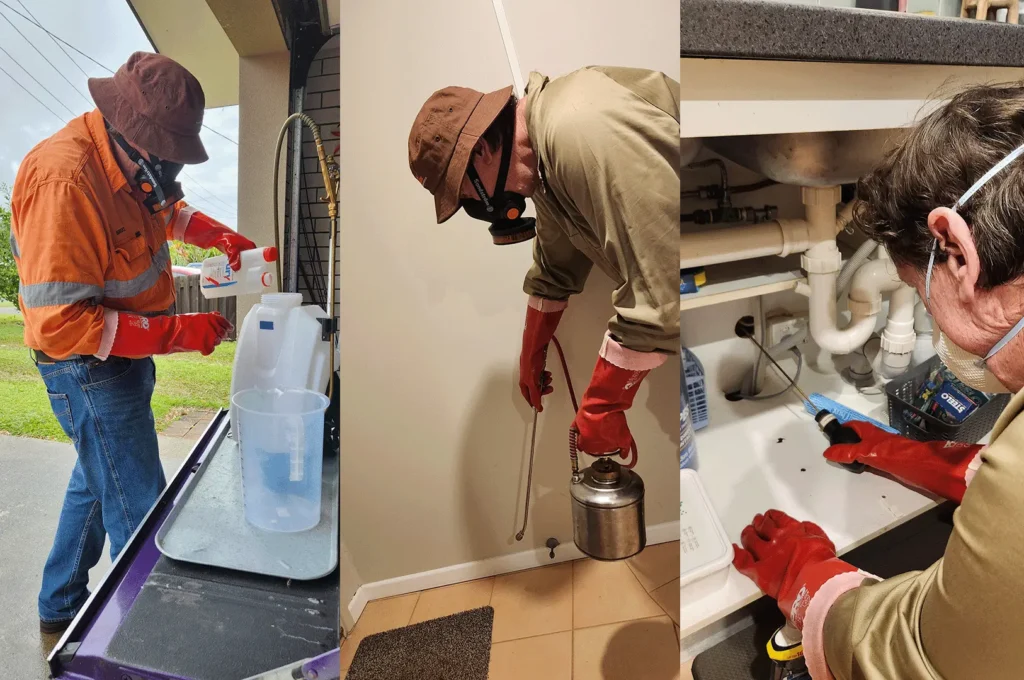
General Pest Management Courses
ProTrain facilitates both Face-to-Face classroom style workshops and distance learning programs for General Pest units of competency.
These programs are designed and targeted towards Pest Management Trainees learning pest management in the workplace whilst under the supervision of a licenced Pest Management Technician.
ProTrain expects that persons wishing to complete this program would already be or about to commence employment as a Trainee Pest Management Technician and be working under the supervision of a Licenced Pest Management technician.
General Pest Control - Urban Pest Management
The course includes 3 units of competency which must be completed in full to enable a qualification to be issued.
ProTrain Pest Management courses are designed to provide trainees with the knowledge and skills to become a qualified Pest Manager.
- CPPUPM3005 – Manage pests without applying pesticides.
- CPPUPM3006 – Manage pests by applying pesticides.
- CPPUPM3018 – Maintain equipment and pesticide storage area in pest management vehicles.
Pre-Requisites
To qualify for entry into this urban pest management workshop and to enable students to apply their training in an industry environment, students are required to either be currently employed, commencing employment or have pre-arranged & documented work placement in the urban pest management sector. This will need to be verified by a ProTrain team member. You will also need a valid Unique Student Identifier, if you do not currently have a valid USI please follow this link here.
Program Delivery
The Face-to-Face Urban Pest Management program consists of four mandatory components. All components must be completed to achieve competency.
A. Pre-Course Online Learning
Before attending the workshop, students complete selected online learning and research activities.
These modules are issued upon enrolment confirmation and prepare trainees for the workshop.
B. Commencement of Supervised Workplace Training
The student must be able to provide evidence of completing at least 10 Urban Pest inspection and management programs (across a range of pests including Cockroaches, ants, spiders, rodents and at least 4 other non-timber pests.) under the DIRECT SUPERVISION of a qualified pest management technician.
C. Five-Day Face-to-Face Workshop
Monday to Friday
- 8:00 am – 4:30 pm
- 8:30 am start in Maroochydore
The workshop includes classroom-based learning and hands-on practical activities in real and simulated environments.
D. Final Workplace Assessment
After completing Components A, B, and C, trainees complete a final workplace-based assessment.
This assessment uses photo and video evidence to demonstrate practical performance against competency requirements in real workplace situations.
Topics
There are several topics that will be discussed in this course.
- Pest biology and management including Cockroaches, Ants, Rodents, Spiders and a range of other Non Timber Pests.
- Legislation and codes of practice and other documents relating to General Pest Management.
- Inspection processes, equipment used and Reporting of General Pests.
- Options and proposals for general pest management (including both Non-Chemical and Chemical).
- Design and implementation of Safe and Effective Pest monitoring and management programs.
- Overview of building maintenance issues methods and their relevance to General pest management programs.
- Client conflict resolution in Pest Management.
- Safe storage and transport of pesticides.
- Management of vertebrate pests including rodents, birds, and possums.
- Pest management of non-vertebrate pests including cockroaches, fleas, ants, flies, biting insects, and stored product insects.
- Pesticide application equipment.
- Technician, client, public and environment safety.
- Pesticide selection and formulations.
- Advances in industry related technologies.
Workshop Practical Component
Candidates should be aware that the Face-to-Face workshops include full practical components which will need to be completed successfully.
- Real workplace inspections, analysis and treatments for both domestic and commercial situations.
- Vertebrate and Non -Vertebrate Pests Environment for inspection and identification purposes.
- Multiple species sample collection and ID’s.
- Selection and setup of equipment for a pest management vehicle
Pest Management - Pest Control Workshop Completion
The workshop is designed to provide each student with the knowledge and skills to move forward in their quest to gain the minimum recommended competency required to be able to carry out pest management work.
To complete the course you are required to:
- Attend and participate in all daily sessions.
- Complete all theory assessments on Non Timber Pest Control.
- Participate in and complete all practical assessments.
- Provide Logbook and Photographic evidence of a number of Non Timber Pest Management programs
- Participate in an a series of Practical Assessments with a ProTrain Assessor.
- You have up to 12 months to complete this qualification.
Successful completion of this course will allow candidates to apply for an occupational licence in most areas of Australia.
Persons seeking to apply for a Pest management licence in Western Australia may be required to meet extra requirements, please contact a ProTrain team member if you wish to discuss this.
What Do I Need To Bring?
You will need to bring:
- Biro
- Pencil
- Calculator to use during assessment
- Suitable clothing and footwear on practical days (typically days 4 & 5) including shirt, long trousers, enclosed shoes, hat & sunscreen
- Suitable torch for inspections
- Clothing to be workplace appropriate.
Course Fees & Inclusions
Course fee:
Maroochydore & Brisbane: $2450
Townsville & New Zealand: $2550
Course fees include:
- Venue and practical site costs
- Consumables and equipment used during training
- Presentation materials
- Textbooks and handouts
- Morning tea and lunch
Payment can be made via direct deposit or credit card prior to workshop commencement.
Frequently Asked Questions
Do I need a job in pest control before I can enrol?+
Yes — for the General Pest course you need to be employed, commencing employment, or hold a documented work placement with a pest management business, plus a valid USI. Part of the course involves completing at least 10 supervised pest management jobs, so you'll need workplace access under a licensed technician. Not sure if your situation qualifies? Contact our team and we'll check with you.
Which units does this course cover?+
Three nationally recognised units: CPPUPM3005 (manage pests without applying pesticides), CPPUPM3006 (manage pests by applying pesticides), and CPPUPM3018 (maintain equipment and pesticide storage in pest management vehicles). Together these form the skill set required for a General Pest licence application in most states and territories.
Can I study this course online?+
Yes. You can choose face-to-face public workshops (Maroochydore, Acacia Ridge/Brisbane, Townsville and Auckland) or online/remote learning at your own pace through our student portal. Both cover the same three units and both include supervised workplace training and a final workplace assessment.
How long do I have to complete it?+
The face-to-face workshop runs five days plus a final practical assessment. However you study, you have up to 12 months from course commencement to complete all components.
Will this course get me a licence?+
Completing the course gives you a Statement of Attainment — the training step. You then apply to your state or territory regulator for the actual licence. See our licensing page for what applies where you work. Western Australia has some additional requirements, so check with us first if you’re in WA.
What do I need to bring to the workshop?+
A biro, pencil, calculator and torch, plus workplace-appropriate practical clothing and footwear (shirt, long trousers, enclosed shoes, hat and sunscreen).
ProTrain reserves the right to postpone workshops should minimum numbers not be met.
| Name | Date | Time | Location | Spaces | Cost | |
| Non-Timber Pest Management Maroochydore | 12 – 16 October 2026 | 08:30 am – 04:30 pm | MAROOCHYDORE | 4 | $2,450.00 |